
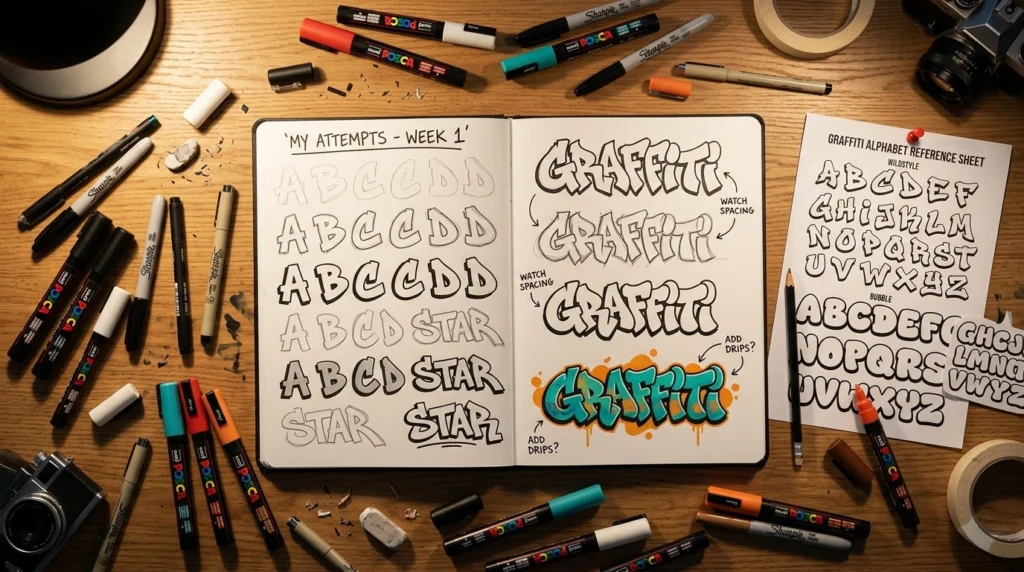
Table of Contents
Learning how to draw graffiti starts with understanding that every piece on every wall came from the same place: someone practicing letterforms in a sketchbook until their hand knew what to do without thinking. There is no shortcut past that stage. But there is a smart order to learn in, and following it will save you months of frustration.
The six steps to learn how to draw graffiti are: choose your tag name, master your tag through repetition, learn straight letters, progress to bubble letters, add dimension with 3D effects, and finally push into advanced styles like wildstyle. Each step builds on the one before it. Skip ahead and it shows.
This guide on how to draw graffiti walks through every step with specific drawing advice, common mistakes to avoid, and the tools that actually make a difference. I wrote this on GraffitiCanvas because most how to draw graffiti guides online either oversimplify it to the point of being useless or skip the fundamentals entirely and jump straight to wildstyle. Neither approach works.
If you have never drawn a graffiti letter in your life, this how to draw graffiti guide is your starting point. If your how to draw graffiti journey has stalled, the section on how to draw graffiti mistakes will probably tell you why.
Step 1 — Choose your tag name
The first step in how to draw graffiti is choosing a name. This is not a casual decision. Your tag is your identity in the culture. It is what people will associate with your style, your walls, your reputation. Pick something you can live with for years.
Keep it short. Three to five letters is the sweet spot. Longer names are harder to write fast, harder to fit on surfaces, and harder to make visually interesting. Most legendary writers have short names: Seen, Dondi, Futura, Blade, Cope, Risk.
Choose letters that connect well. In how to draw graffiti practice, certain letter combinations flow better than others. Letters with curves (S, C, O, R) connect more naturally than angular ones (K, X, Z). Test your name by writing it fifty times and see if the letters want to work together or fight each other.
Part of learning how to draw graffiti is respecting names already claimed by established writers. This matters in the culture. Do some research on Bombing Science and graffiti forums before committing.
Step 2 — Master your tag through repetition
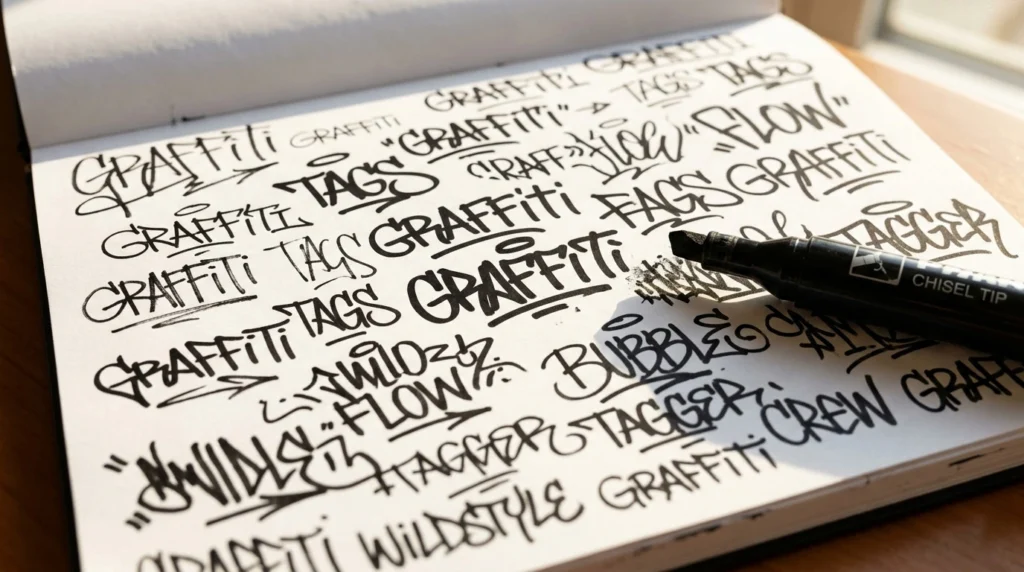
Your tag is the foundation of everything in learning how to draw graffiti. When you learn how to draw graffiti, the tag is a one-line, one-color signature written fast. Every writer in history started here. If your tag is sloppy, nothing built on top of it will look right.
When figuring out how to draw graffiti tags, fill entire pages. Write your name a hundred times per session. Change the lean angle. Change the stroke weight. Change the speed. Some attempts will look terrible. That is the process. You are training your hand to find the version that feels right.
In how to draw graffiti tags, pay attention to rhythm. A good tag has flow between letters. Each character leads into the next with a logic that looks effortless. Add decorative elements like stars, underlines, or arrows only after the base letters feel solid. Decoration cannot fix weak fundamentals.
Anyone learning how to draw graffiti should know that handstyle is the word for a tag that has reached an artistic level. Getting there takes hundreds of pages. Writers like Chaka, Tempt, and Cost are remembered not for elaborate pieces but for handstyles so distinctive they became iconic.
For how to draw graffiti tools at this stage, a good set of markers is all you need to learn how to draw graffiti. We reviewed the best graffiti markers for 2026 with hands-on testing. A chisel-tip marker gives you thick-to-thin stroke variation that builds toward can control later.
Step 3 — Learn straight letters
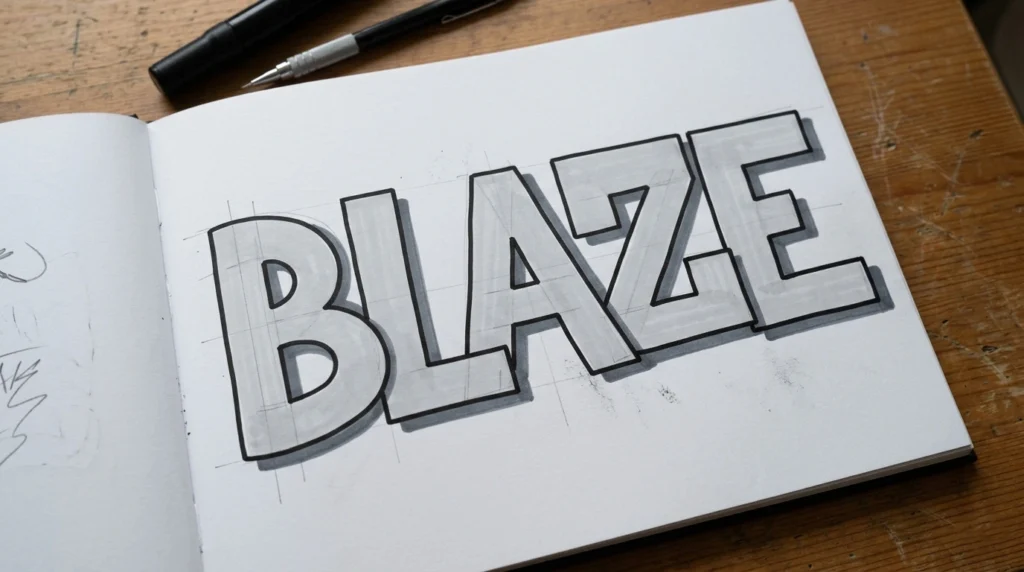
Straight letters are the first real test when you learn how to draw graffiti beyond a tag. You take your name and draw it in clean, blocky, readable letterforms. Even spacing. Consistent stroke width. Sharp edges. Two to four colors.
When learning how to draw graffiti straight letters, start with pencil. Sketch a baseline and a cap height line. Every letter sits between those two boundaries. Draw the skeleton of each letter first, just the basic structure, then build the block forms around it.
Common mistakes at this stage of learning how to draw graffiti: uneven letter sizes, inconsistent spacing, and wobbly outlines. The fix for all three is planning. Sketch the full word lightly before committing to any final lines. Adjust proportions while the marks are still faint.
Once you understand how to draw graffiti straight letters cleanly, add a simple drop shadow. Pick one direction, right and down is standard, and apply the same offset to every letter. Inconsistent shadows make the whole piece look accidental.
For a deeper breakdown of how straight letters work across the full alphabet, check our graffiti styles guide. If you want to see how to draw graffiti straight letters for every letter A through Z, GraffSpace can generate a full straight letter alphabet in seconds. Print it out and keep it next to your sketchbook as a visual reference while you practice.
Step 4 — Progress to bubble letters
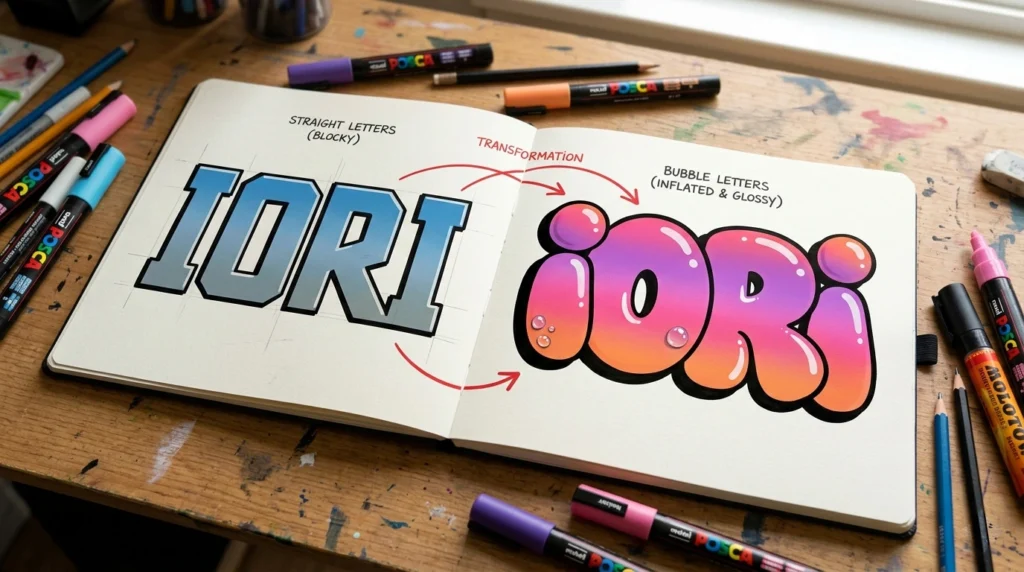
Bubble letters are the step where the process of how to draw graffiti starts to feel like actual graffiti. You take your straight letters and inflate every edge. Round every corner. Make each letter look like it could pop.
The trick when learning how to draw graffiti bubble letters is consistency. Every letter needs the same level of inflation. If your B is fully puffed and your L looks flat, the word reads as unfinished. Sketch the straight version first, then build the bubble forms around it with equal curves on every character.
As you learn how to draw graffiti in this style, color becomes important. Because bubble shapes are simple, the palette does most of the visual work. Glossy finishes, candy tones, and strong outline-to-fill contrast are what make bubble letters pop. Two or three colors maximum. More than that and it gets muddy.
In the history of how to draw graffiti, Phase 2 from the Bronx pioneered bubble letters in the early 1970s. Studying his work and the writers who followed gives you a sense of how far this simple style can go. We covered the full history and technique in our calligraffiti guide and our graffiti characters tutorial, both of which connect to this stage of development.
A method that speeds up this how to draw graffiti stage: generate your name in bubble style on GraffSpace, print the result, and use it as a proportions reference next to your sketchbook. You are not tracing. You are training your eye to see what consistent inflation looks like across different letters. The free tier handles this.
Step 5 — Add dimension with 3D effects
Once your bubble and straight letters are consistent, the next step in how to draw graffiti is adding depth. 3D effects make flat letters look like they are lifting off the page or receding into space.
When learning how to draw graffiti in 3D, start with one-point perspective. Pick a single vanishing point behind your letters. Every depth line converges toward that point. This creates a consistent 3D extension on every letter without you needing to calculate angles for each one individually.
In learning how to draw graffiti with depth, shadow and highlight have to agree on where the light source is. If the light comes from the upper left, every letter gets a highlight on the upper left edge and a shadow on the lower right. Inconsistent lighting kills the illusion instantly.
Chrome effects are the advanced version when learning how to draw graffiti in 3D. You are simulating how light bends across curved metal. This requires studying real reflective objects and translating those observations to your letters. The artist Daim built his entire career on 3D graffiti lettering and his work is worth studying.
If you want to see how to draw graffiti in 3D before attempting it by hand, GraffSpace generates 3D chrome letters on realistic surfaces. It helps you understand where highlights and shadows fall across each letter before you have to figure it out with a pencil.
Step 6 — Push into wildstyle and advanced styles
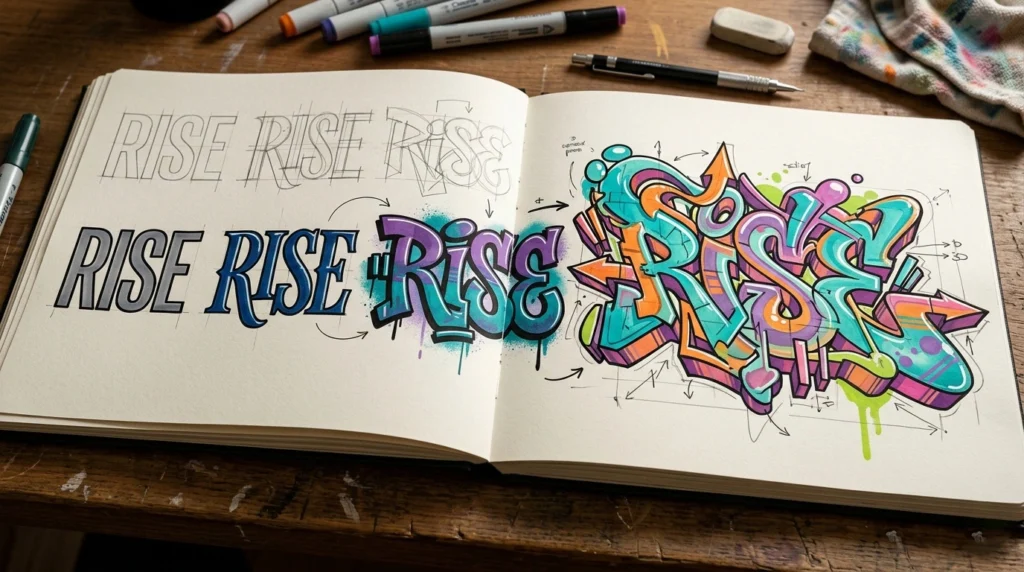
This is the step where learning how to draw graffiti becomes a years-long practice. Wildstyle takes every principle you have learned, letter structure, balance, flow, connection, and pushes them past readability into controlled abstraction.
Do not jump to wildstyle before your straight and bubble letters are solid. The most common mistake when learning how to draw graffiti is adding arrows, spikes, and extensions to letters that do not have strong fundamentals. That produces visual noise, not wildstyle.
When you learn how to draw graffiti at this level, start with semi-wildstyle. Take your straight letters and add one element at a time. An arrow extending from a serif. A connection linking two letters. A spike creating negative space. Build complexity gradually instead of trying to go fully abstract in one attempt.
In how to draw graffiti at the highest level, Tracy 168 is widely recognized as a pioneer of wildstyle. Dondi White and Zephyr refined it further. Study their work to understand how abstraction and readability coexist. Every arrow and connection in their pieces serves the composition. Nothing is random.
Beyond wildstyle, styles like calligraffiti blend traditional calligraphy with graffiti energy. We wrote a full tutorial on that style. If you are interested in adding characters to your pieces, our graffiti characters guide covers that progression.
What tools you actually need to learn how to draw graffiti
You do not need much to start learning how to draw graffiti. A sketchbook and a few markers will carry you through the first several months. Here is the real list.
To learn how to draw graffiti, start with a sketchbook with thick paper. Thin paper bleeds with markers and tears with erasing. Look for 100gsm or higher. Size does not matter much but A4 or larger gives you room to work.
The core how to draw graffiti tools are black markers in two or three tip widths. A fine point (0.5mm) for outlines and details. A medium chisel tip for fills and tag practice. A fat chisel for blockbuster letters and large fills. We tested and reviewed the best graffiti markers for 2026.
For how to draw graffiti with color, you need colored markers for fills. Prismacolor and Copic are the standards for blackbook work. Start with a set of six to twelve colors. You do not need fifty shades. You need to understand how three or four colors interact.
When your how to draw graffiti practice moves to walls, start with quality spray paint. Montana, Ironlak, and Molotow are the brands experienced writers trust. Fat caps and skinny caps give you line control. But that comes later. Spend months in the sketchbook first.
One more tool worth mentioning: GraffSpace is an AI-powered studio built specifically for graffiti. It is useful at every stage of how to draw graffiti practice. At the tag stage, generate your name in different styles to find direction. At the straight letter stage, print a reference alphabet. At the wildstyle stage, generate twenty variations and study which compositions work. The free tier is enough for all of this.
Mistakes that keep beginners stuck
I see the same problems in every beginner learning how to draw graffiti. Fixing even one of these how to draw graffiti mistakes will produce an immediate jump in quality.
Starting with wildstyle. In how to draw graffiti progression, it is the flashiest style and everyone wants to do it first. But without months of straight and bubble practice, your wildstyle will be a mess of random arrows going nowhere. Earn it.
Ignoring negative space. In how to draw graffiti, the empty area between and around your letters matters as much as the letters themselves. Cramped letters with no room to breathe look claustrophobic. Study how experienced writers balance filled and empty space.
Copying instead of studying. Nobody learns how to draw graffiti by tracing. Looking at another writer’s piece and tracing it teaches you nothing about how to draw graffiti. Instead, study the piece, close the reference, and try to rebuild it from memory. The gaps in your memory are the things you have not learned yet. That is where the real practice happens.
Never finishing a piece. When learning how to draw graffiti, beginners start thirty sketches and finish none. A finished piece, even a bad one, teaches you more than ten abandoned ones. Take every sketch to completion. Outlines, fill, shadow, background. Then look at the result honestly and identify one thing to fix next time.
Practicing without references. To learn how to draw graffiti properly, you need to see how experienced writers handle letters. Books like Subway Art by Martha Cooper and Henry Chalfant are the gold standard. We reviewed a great beginner workbook as well. Study other people’s work, then develop your own voice through the filter of what you have learned.
Moving from sketchbook to walls
There will come a point where your sketchbook practice is solid and you want to apply how to draw graffiti knowledge on an actual surface. The jump from paper to wall changes everything.
Anyone going from paper to walls in their how to draw graffiti journey will discover that spray paint behaves differently from markers. The line width depends on your distance from the surface, your speed, and the cap you are using. Can control takes its own practice period. Start on a legal wall or a practice board. Do not waste your first cans on a surface where mistakes are permanent and public.
Scale is another challenge when you learn how to draw graffiti on walls. A letter that looks balanced at six inches tall might look top-heavy at six feet tall. Practice stepping back from your wall frequently to check proportions from a distance. What reads up close is not always what reads from across the street.
Surface matters in how to draw graffiti on real walls. Brick absorbs paint differently than concrete, which absorbs differently than metal. Your colors will look different on each surface. Your drips will behave differently. Learning how to draw graffiti on paper gives you letter knowledge. Learning how to draw graffiti on a wall gives you the material knowledge. Both are necessary.
FAQs :
How long does it take to learn how to draw graffiti?
Basic tags and straight letters take one to three months of daily practice. Bubble letters and simple pieces take three to six months. Wildstyle and advanced styles take years. There is no fixed timeline because it depends entirely on how much you practice and how honestly you critique your own work.
Do I need artistic talent to learn how to draw graffiti?
No. Graffiti is a skill built through repetition, not a talent you are born with. Anyone who fills enough pages with practice will develop clean letterforms. The writers who look naturally gifted have simply put in more hours than you have seen.
What is the best graffiti style for beginners?
Start with tags, then straight letters, then bubble letters. These styles teach you letter anatomy, spacing, and color without overwhelming you with complexity. Do not touch wildstyle until your straight letters are consistent.
Can I learn how to draw graffiti from online tutorials?
Yes, but tutorials alone are not enough for how to draw graffiti mastery. They show you technique. Practice builds the muscle memory. Watch a tutorial, then fill ten pages applying what you learned. Repeat. Our tutorials on graffiti characters and graffiti styles both follow this approach.
What markers should I start with?
A chisel-tip black marker for tags and fills, a fine-point black marker for outlines, and six to twelve colored markers for fills. Prismacolor and Copic are the most popular for blackbook work.
Is graffiti legal?
Graffiti on private property without permission is illegal in most places. Legal walls, permission walls, and designated graffiti areas exist in many cities. Always get permission before painting on any surface. Practice in your sketchbook, on legal walls, or on your own property. We wrote about the broader context in our graffiti vs street art breakdown.
What I wish someone told me when I started
Nobody learning how to draw graffiti gets good fast. The people whose work you admire have years of ugly sketchbook pages you will never see. That is the part of learning how to draw graffiti that nobody posts online.
In how to draw graffiti, do not compare your page fifty to someone else’s page five thousand. Compare your page fifty to your page one. That gap is your progress. It is the only comparison that matters.
Fill the sketchbook. That is how to draw graffiti. Start the next one. Keep going.
Generate your first reference sheet at graffspace.com and start drawing today.